7-J1, Main Canal Bank, Johar Town, Lahore.
  info@fdp.com.pk
7-J1, Main Canal Bank, Johar Town, Lahore. info@fdp.com.pk


 September 14, 2018
Agricultural Machinery maintenance is very crucial for successful agricultural production. It aims the availability of machines and related equipment for cultivation operation. Moreover, it is one major cost for agriculture operations. Thus, the increased competition in agricultural production demands maintenance improvement, aiming at the reduction of maintenance expenditures while keeping the safety of operations. Preventive maintenance is an extensive term that consists of a set of activities to improve the overall reliability and availability of a system. In general, preventive maintenance activities include inspection, cleaning, lubrication, adjustment, alignment, and/or replacement of sub-systems and sub-components that are fatigued. Preventive maintenance activities can be classified in one of two ways, component maintenance, and component replacement.
Maintenance is needed to ensure that the components carry on the purposes for which
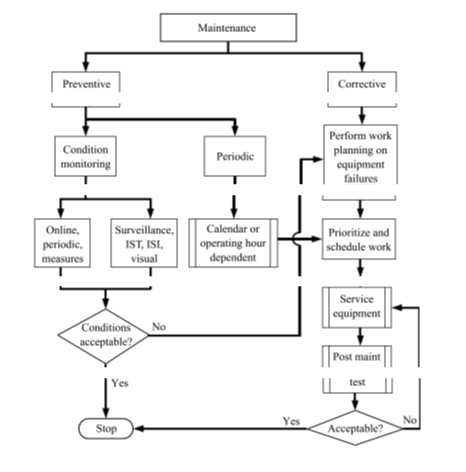
they were designed. The basic objectives of the maintenance activity are to deploy the minimum resources required to make sure that components perform their intended purposes properly, to ensure system reliability and to recover from breakdowns. As is shown in Figure, the overall maintenance strategy strategy consists of preventive and corrective maintenance programs.
Maintenance is of two types, Preventive and Corrective. The corrective (also known as unscheduled or failure based maintenance) is carried out when agricultural machinery stop working or failures occur in any of the components. Immediate replacement of parts may be necessary and unscheduled downtime will result. But this is costly must be avoided. By contrast, the objective behind preventive maintenance (PM) is to either repair or replace components before they fail. As is shown in Figure 1, preventive maintenance includes periodic and condition-based maintenance. Periodic maintenance may be done at calendar intervals, after a specified number of operating cycles, or a certain number of operating hours. These intervals are established based on manufacturers’ recommendations. An alternative is to lessen against major component breakdown and system failure with condition-based maintenance (CBM). CBM process requires technologies, people skills. So, this involves acquisition, processing, analysis and interpretation of data and selection of optimal maintenance actions and is achieved using condition monitoring systems.
Agricultural machinery have to cope with time and place-specific conditions. This explains the time-variant character of these systems. A change in crop variety, crop moisture, field slope, temperature, etc., may result in a different process characteristic. On the basis that a “significant change is indicative of a developing failure. with good data acquisition and appropriate signal processing, faults can thus be detected while components are operational and appropriate actions can be planned in time to prevent damage or failure of components.
Machine fault diagnostics is a discovery procedure based on mapping information in the measurement features in the feature space to machine faults in the fault space. Detection of a potential failure will result in diagnostic action which is a proactive activity and usually begins with a condition based maintenance process.
The purchasers of agricultural equipment have increasing demands about the quality of repairs. The breakdowns of agricultural machines often interrupt the technological process. The time of machine repair during intensive works in farm is a crucial element in the quality of their realization. The level of execution of the routine technical maintenance and repairs is one of the most important factors having the essential influence on the process of machines, tractors and agricultural transport means wear. The factors which have a decisive influence on the maintenance and repairs are the workshops equipment of technical facilities with modern tools and devices, as well as the technical level and the qualifications of repair staff.